Thursday, September 29, 2016

Rainbow ..The good-to-read how's and the wow's

For those of you who completely hated me for my last post, for those of you who got bored to bits, this post is for you. Sorry, I think the math and the physics got me carried away and I got terribly excited at the new ways I learnt to explain refraction and the bending of light that I tried sprawling it all over the last post. So, leaving out the unnecessary details and the scary did-it-myself illustrations, and the wierd looking new terms, this is how the previous post would've been...

All of us love to see a rainbow. Love its colourful hue and the way it majestically appears across the
light blue sky. We know it appears when it is raining a bit and when there's sun too. I didn't know so long that the rainbow will appear only when our back is towards the sun and the rain is in front of us. So, that's a new condition we've learnt. Rainbow is made up of 7 colours - Violet, Indigo, Blue, Green, Yellow, Orange and Red. And why does a rainbow appear .... When sunlight enters into the water droplets, the droplets of water act as a prism and split the light into its constituent 7 colours, thereby resulting in a rainbow. Most of us would know this and would stop at that.

Have we ever wondered, why the rainbow is a bow and not a straight line? Why should it be an arc? I got a dream one other day that someone came sliding on a rainbow and broke it thus. ( The detailed background story of that dream in the previous post.. which you can conveniently ignore ) And uptil then, I never gave this question a thought too.. Amazing right.. the things we take for granted. When a prism splits light into 7 colours, the colours show up as a straightline or a band, one below the other. So how does this fancy bow or arc show up? Did newton give this a thought ever? Would he have?

So, first things first. How do we see colour or how do we see anything? The light that falls on the object must reach our eyes, or the colour reflected from the object must reach our eyes. Isn't it? So, when we see a rainbow, we see an arc of red first, then arc of orange and so on.. till we see an arc of violet. Which would mean, the raindrops on top, give us red. And all the raindrops in that particular arc, send red light to our eyes. Similarly, all the drops below the red arc, send orange to our eyes... and so on till the voilet arc raindrops.

Ok, we kind of understand what must be happening for the rainbow to be formed as an arc. There is one major question though, that must be arising in most of your minds. Why does every raindrop just send only one colour to my eye. What's with the raindrops? If they are supposed to behave as a prism and split the light into 7 colours, they must be sending 7 colours to my eye, and the whole thing must be a mess, albeit a colourful mess. How come it isn't so?

If every raindrop is sending me exactly one colour and in that particular order, then, it must mean, when the colours are split, they are split up at different angles, that only one angle reaches my eye. isnt it? That is to say, the first raindrop does split the light into 7 colours, but all the colours are split at different angles, and they all come out in the same direction, but separated. That way, only the colour whose direction is exactly towards my eye, reaches me from raindrop1. Similar situation with the other raindrops too.

To explain it more, listen to this. Raindrop1 splits the colours in this order : violet, indigo, blue, green, yellow, orange, and red. All of these colours separated out. Now, according to what we see, red appears first on the rainbow right? So, raindrop1 sends red to my eyes, and the other colours go above my eyes. Now, imagine there is a raindrop2 just below the raindrop1. This fella is below raindrop1 isn't it. So his red ray, will go below my eye. I can't see his red. But because he is just below, maybe I can see the ray which is just above red ray, the orange ray. So, from raindrop2, orange ray reaches my eye. So in the sky, I see red first, then orange. This same logic can be extrapolated to understand the rest of the rainbow.

Now, to explain the arc. Oh boy! That's the difficult part. Let's dust our thinking hats and wear it on. We need it more than ever. We infact need an upgraded version of our thinking hat, maybe thinking hat 10.0 ( like the recent ios 10.0, nice and new) Apparently, this rainbow is not an arc exactly, it is a part of a circle. That is, it is actually a circle, but we get to see only a part of the circle, and hence we see only an arc. To help you understand that part, why don't you watch this video from youtube where this person creates her own rainbow in her garden with a hose pipe. You see, its a full circle. And in our case, for the sheer size of the circle, half of it is obstructed by the ground, so we see only an arc.

Anyways, when I say circle, what is that, that first comes to your mind? If you ask me , I say, radius, centre point ( and my dear friend lavanya, whose face is so round that it seems like a perfect circle, with the centre point lying somewhere on the ridge of her nose.) So, there must be a centre somewhere for our rainbow circle. What are the properties of a circle? Every point on the circle is at the same distance from the centre. That's one point. Imagine drawing a circle with a geometrical compass. The compass has two hands. One hand has a pointed end, and wherever you place that end on the paper, becomes the centre of the circle. Isn't it? The second hand has a pencil attached. So, keeping the centre hand fixed on a point on the paper, you rotate the pencil hand freely to get a circle. And in the meantime, you make sure you don't disturb the distance between the compass hands, that is you wouldn't change the compass angle isn't it. That angle is fixed now, till you finish drawing the circle. That's a new point about a circle. Maybe that would help in our case. Let's see.

What has angle to do with any of this. In physics, especially when it comes to light, angle is very important. For instance, there is something called critical angle. The light when it reaches a surface at an angle greater than the critical angle for that surface, it reflects back, that is, goes back instead of moving forward into the new medium.Just take this much from the previous sentence - Angles decide the behaviour of the light, maybe to be precise, their path, say.

So, now let's imagine a huggggggeee compass, when I say hugggeeee, I'm definitely underplaying on the word huggggee, so please imagine an accordingly hugggge compass. Compass has two hands, which are attached at a point. Let's call it pivot point. Now, let's keep the pivot point of the huggge imaginary compass near my eye. Ok.. ( don't worry. It's imaginary. Won't hurt me. ) Now, the hand that holds the pencil is pointed at the raindrop1, the raindrop that let its red light reach my eye. The raindrop that gave me the red ray for the red part of the rainbow. So, now, that raindrop1 should look red to me. I keep the pencil part of the huggge compass on that red dot. Listen carefully now. I keep the sharp pointed hand of the compass on an imaginary line, that is parallel to the sunray that enters the raindrop1. Or why take so much trouble. If that's difficult to imagine, just imagine for now, that you know the centre of the rainbow circle and you keep the pointed part of the compass there. Like how you would draw a circle with an ordinary compass, kindly imaginarily draw a huge circle with this hugggge compass, keeping the pointed part fixed on the imaginary centre and letting the pencil hand rotate freely. That would give me a circle, a red circle to be precise. This entire circle, or how much ever is visible to me, will look red. This is the red part of the rainbow.

Now, keeping the sharp ended compass hand still at the imaginary centre, and the pivot point of the compass still near my eye, I change my pencil to an orange colour pencil, and I point my orange pencil on the raindrop2, the raindrop that sent orange ray to my eye. I let the orange pencil of my compass, rest on the orange dot (raindrop2). In the process, I've reduced the angle between hands of the compass, did you notice that. I now draw a circle, the same way, and I end up getting a nice orange circle right below the red circle and a tad bit smaller. This is the orange part of the rainbow. Similarly, you can repeat the same exercise till you get all the 7 wonderful circles neatly arranged to form the rainbow.

Did you notice the difference between this post and the previous one (if you had the patience to go through the previous post, that is)In the last post, we learnt the concepts and we arrived at the rainbow circle. In this post, we started from the circle and tried understanding what could’ve happened. See how much a change in direction or a new way of looking eases things for us. The power of a new perspective. Ooopsie.. These days I tend to get philosophical every now and then! Kindly ignore I said that. We are here on a science mission with our 10.0 thinking hat to our aid. Right? 

So where were we… angle and rainbow circle. The angle of the compass.. looks like that decides our rainbow, isn’t it. And the precise angle decides the precise colour of the rainbow. But why that angle, how to arrive at that angle, what’s this imaginary centre point, we needn’t know. We just need to know that not all the rays that enter the raindrop1 send red to my eye. Only the one that enters the drop in a particular angle, gets manipulated by the water drop in such a way that it sends red to my eye. Angle is the key here. Fair enough right ?

The next important thing is this. If you remember, the pivot point of the hugggeee imaginary compass was near my eye. So the entire circle or the set of 7 concentric circles were drawn with the pivot point fixed to my eye. Imagine, you are standing right next to me, by my side.   If you look in the direction of the raindrops, (with the sun behind you as well), and if you hold an imaginary hugggeee compass near your eye and try simulating the same thing, you would see a rainbow too (maybe) if the conditions and the angles were right. But, the very important point is, your rainbow is not the same as mine. Yours is a different rainbow. The rainbow lies in the eye of the beholder. Oh dear. In one of the previous posts we read that the sky you see is different from the sky I see which is different from the sky the animals see.. now we say the rainbow you see is different from the rainbow I see..  Is anything the same for any two people at all… I’l give you a minute to let that settle.


This would also mean, you can never reach the end of a rainbow. Because, as you move, (to a certain extent,) the rainbow you see will keep moving, till a point it doesn’t appear at all. So, you can never reach the end of it. Which means, you can never get to the mythical pot of gold hidden at the end of the rainbow. Now what is the moral our ancestors wanted us to take from this. Did they mean to say, don’t go looking for hidden pots of gold because they are elusive, instead make your own gold. Or did they mean metaphorically that if the end of the rainbow keeps moving, meaning instead of one pot of gold, the earth itself is golden, so take care of it and respect it. We’l never know the ways of our ancestors, however, we know one thing. Rainbows are pretty magical-cum-logical circles which appear every once in a while to light up our days. 


Rainbow ... The why's and the wow's

You know how frustrating it feels when a tune or half muddled lyrics is stuck in your head and you just can't put a finger on the song... I had one such tune for years. After lot of indexing ans searching through my memories, the only information my brain could come up with was , it ( perhaps ) starts with the words - rainbows and roses. And that it is something to do with my childhood memory. 

One normal day, amongst the things in our weekday routine , I went to drop my son in his music class. I heard a song and I shrieked involuntarily ," THATS IT!!!  That's THE song". And before the teacher could throw me and my son out of the class for disturbing her, I gave a sheepish grin and dropped my son and slid out with a huge content grin writ all over my face. I solved the puzzle finally. It was a song from the movie sound of music and it starts like this - raindrops and roses. Not bad. I was close. Maybe I associated happiness with rainbows. Understandable. I'm sure most of us  do that. we all love rainbows don't we..  The colourful hue, the lovely bow shape.. My face still lights up if I see one, and I still make it a point to stop and look at it when it appears. 

That night I had a dream. Lovely garden, full of roses. I love it there. There's thunder, it begins to drizzle .. A lovely rainbow appears ... And suddenly, out of nowhere, the music teacher comes sliding down the rainbow!! ( I'm going to give you a minute to process that..) Apparently, I woke up screaming , "She broke the rainbow. She broke it"... Hilarious isn't it. And partly scary too. ( absolutely no offence meant to the teacher.. Just the fact that the rainbow was broken scared me ) 

Anyhoooo... Let's try and forget about the dream, and get on to rainbows. What do we know already about them... rainbow is an arc that magically appears across the sky when it is raining during the day, keywords here being - arc, rain, day. It comprises of 7 colours - violet, indigo, blue, green, yellow, orange and red, in that particular order with red on top of the arc and violet towards the bottom. The colours are abbreviated or acronym-ed "VIBGYOR". Did you know, newton was the one who conducted a prism experiment and found out that white light comprised of these colours. And apparently, he first categorised them as 5 colours, and later went on to make it 7 colours, in line with the notes in music and with the days of the weeks.

And this phenomenon of splitting of the white light into 7 colours is called dispersion. Before getting into hunky dory details, let's talk motivation . Who amongst you has heard of the pot of gold at the end of the rainbow. How can we get there ? Maybe if we understand how rainbow is formed, we might be able to do some mighty calculations as to where the end of the rainbow might fall.. super cool isn't it? Wouldn't you want to try? Let's buckle up then....

Where were we... yes, dispersion. Dispersion is the splitting up of white light into its constituent colours. Before we get to the why, we need to know the 'when'. When does it split into 7 colours? It splits only when it enters into another medium of different density. Isn't it ? In newton's case, the prism and in the case of the rainbow, it splits when it enters water droplets. What happens to light when it enters another medium?

Let's think. Let's imagine a kid running, running on ground. He runs so fast, that he reaches the
sea shore ( we are assuming ideal conditions, like no traffic and that it's safe for a kid to run that far ) now he is running on the sea shore. He will involuntarily slow down isn't it... because of the beach sand. Now he runs to the waves and wants to play in the waves . His pace will slow down even further because of the water isn't it ? Now imagine another kid ( say his brother ) running along with him. He will also slow down when he reaches the sea shore and the sea, but the amount of speed he loses will be different from that of his brother. Both of them slow down in a different media, but the first kid slows down a lot and the second slows down a little . Different people react differently to similar situations isn't it . Remember this for now. Let's discuss another phenomenon. 

Imagine a group of people, walking along each other, side by side, in a straight line. (This is called the marching soldiers analogy) Draw a line in front of them, just to simulate a different medium situation. ( The line is not parallel to the line of people) And tell them that they have to take long steps when they are in medium one , and as soon as they cross the line, they have to take short steps. If you carefully observe, the line of people, when they are crossing the line, change their direction. That is, their path gets bent. And once they cross the medium, they will go straight in the bent path. Why does that happen? When person1 reaches the line, he starts taking small steps. But, when he reaches the line, the others still haven't. They still take long steps. So the line bends and takes a different direction. Do you get it? That's exactly what happens to the ray of light too when it enters a denser medium. It gets bent while entering the medium. This phenomenon is called refraction

Now, along with the bending, we know that the ray slows down. ( like we discussed in the para, a little above ) what happens is, each of the seven colours, have their own way of reacting to the denser medium. All of the colours slow down, but they slow down at different paces. Hence they split and you get to see them distinctly. Lovely isn't it. I love it when the 'aaha' feeling settles on my brain. 

Applying all this knowledge to a light entering a raindrop, this is what happens. Light from the sun, when it reaches the water drop, first, gets refracted, that is bent and moves tad bit slower. In the process, it splits into 7 colours. When this band of colours reach the back of the drop, they bounce from it like light would bounce from a mirror or a reflective surface. This is called total internal reflection

To understand this, let's look a little deeper into refraction, that is, the Bending of light when it
enters a different medium. The different medium either can be denser or less denser than the first medium. And the angle of bending and he direction of bending depends on whether medium 2 is denser or less denser than medium 1. For example, when light enters from air to water, that is from less dense to more dense medium, the ray bends towards an imaginary perpendicular line drawn at the point of incidence of the Ray of light on medium2.  

The inverse case, when light moves from water to air, it bends away from the imaginary
perpendicular line drawn at the point of incidence of the light on air. The amount of bending depends on the refractive index of the medium 2, let's say density of medium 2 for all practical purposes and to ease our understanding. And it also depends on the angle of incidence, that is, The angle with which the light strikes the medium 2. The more the angle of incidence, the more the Ray will bend away from the perpendicular line. At one point of time, it will reflect back into medium 1 itself instead of coming through medium 2. That is total internal reflection. And that incident angle after which the rays will reflect back is called critical angle. 

This is not a new concept you know, even if you felt that the names and the terms are new. I'm sure all of would've seen a mirage. If not in a desert, for sure when travelling by road on a real sunny day. You might see puddles of water on the road that disappeared when you approached them. That is a classic case of total internal reflection. 

Just to recap, white light enters the water droplet, that is from a less dense medium air to the more dense medium water, it refracts, and splits into 7 colours. Now when it reaches the back of the drop, it's time to come out. That is, from the more dense water medium to the less dense
air medium. It so happens, that at a particular angle of incidence, this ray gets total internal reflected back to the water medium and reaches the front of the water drop where it tries coming out of the water drop. Here, it gets refracted again and comes out as a band of colours. ( second refraction, so again speed of the individual colours and the angle of refraction differs and they separate out )  phew !!!

What would you do, if I told you that, that, was the easy part so far. We have accounted for the colours in the rainbow.. good job !! ( like how my son would put it ) So when sunlight enters the water drops in the rain, it splits into seven colours. If u remember the prism experiment from school, the rays split into 7 colours like a band . That is, straight line. There is no curve. So how does the bow in a rainbow appear.. this is the most crucial part with regard to the pot of gold. So pay attention!

What if I told you , the rainbow is actually not a bow but a circle. A 'raincircle'. Doesn't sound nice na. "Raincircle". I personally prefer the bow. The rainbow. It's got a nice ring to it! However, sadly so, it's a circle it seems. Sometimes, most of the times, we just don't get to the see the bottom part of the circle. And what's visible, becomes a bow! I'm sure you are already upset that this article is seeming like a science lesson, especially a physics one.. oh boy!! I hear you. I was scared of physics too from back then as a kid. So, just to bring in your trust back and more so to give you a break, try this at home. Go to your garden, where there's ample space. Turn your back to the sun, take a hose pipe in your hand and spray water in front of you. And when you see the 'raincircle' , come back here to continue. You can also alternatively search for 'make your own rainbows' in youtube or the internet. Or maybe watch this link from youtube.

For those of you who (correctly so) wondered how trigonometry would help us understand the world and why all of us were asked to search for theta in a scary looking polygon with many angles, I'm going to give you a good news. One concept of trigonometry here is going to help you understand the bow in a rainbow. Wow!! Finally, I get to use my trigonometry after all . This one is real simple, trust me. 

Remember the concept of alternate angles? I remember the alphabet 'z' when someone says
alternate angles. My son, when in lower kg, used to say this when I said 'z'. " go to the right, slant right down, and go to the right again". Let's refer to the angle between the first go-the-right and the slant-right-down as angle one and the angle between slant-right-down and the second go-to-the-right as angle two. Apparently, angle one and angle two are alternate angles and are equal ( the prerequisite being, the two go-to-the-right lines are parallel to each other, and the slant-right-down line is a straight line) 

That's it, no more new physics concepts, or no trigonometry concepts. Just imagine this. You are standing facing the rain, with the sun behind you. The sun rays reach the raindrops in front of you, get refracted, reflected and again refracted out as a band of colours. Each colour gets refracted at a different angle. So whichever colour reaches your eye, you see that corresponding colour on top. Isn't it? Look at this illustration. Red deviates the most, so I see red on top. Remember, Violet deviates the least. Raindrop1 , has split the light it received into 7 colours, and only the red reached my eye.. the rest of the colours went above my eye. As long as they didn't reach my eye, I can't see them. Raindrop 2, which was a little below raindrop1, sends orange to my eye and the rest go above and below my eye level. So , I see orange under red. You get the logic.. so on... till violet . That explains the order of the colours. 

Now for the circle or the bow if you may, the angle in which the rays enter the water drop is key to the total internal reflection to happen and hence for the colour to reach my eye. Isn't it. Now let's think, raindrop1 has sent red to my eye. Which other raindrop can do that.. that is, which other drop can send red to me. The raindrops where the angle of incidence is the same. Right ? Those drops would send red colour to my eye. For easy visualisation, imagine a z here. That is, imagine the ray from the sun to the drop as the first go-to-the-right, and the Ray that eventually comes out of the drop  and enters my eye as the slant-right-down. Imagine the Second go-to-the-right as an imaginary line parallel to the first go-to-the-right line. That's a complete z. 

Applying the alternate angle theory, the angle the ray reaching my eye makes with this new imaginary line is all we need to worry about. Keeping this angle constant, I can make a
complete circle of water drops. Isn't it? That is, imagine holding a compass. Where the compass-hand holding a pencil is the Ray that reaches my eye, and the imaginary line is the other hand of the compass that remains fixed. Rotating the compass-hand u can draw a circle isn't it. And the angle of the compass is still fixed. So all the drops that fall in the circle, will send the same red colour to my eye. Because the angle of entering the water drop will be the same for all the drops and hence will produce the same beam of light where red reaches my eye. That explains the red part of the circle. And similarly the same logic will explain the remaining colours. Why don't I see the circle and why do I see the bow.... cause the below part of the circle is obstructed by the earth I'm standing on. Hence a rainbow.. and not a rain circle. Yay!! I told you I liked the ring to the rainbow! 

Oh no, now does this mean, the beauty of the rainbow also lies in the eye of the beholder. It's an illusion is it ? If the angle the  ray makes with the eye matters, then will it move when I move? Oh oh... will I ever be able to get to the end of the rainbow.. our ancestors were real clever people isn't it.. more than clever, I think the word wise would be more apt. They've left us stories about pot of gold at the end of the rainbow, only to make us go berserk about it and let us learn a lesson that we shouldn't pin our hopes on the elusive pot of gold which is hidden but instead spend the time earning and making our own pot of gold maybe. Anyways, don't worry. Illusion or not, we still have the rainbow, and magical or logical, it is a wow, a wonder of the world around us! 


References

https://en.wikipedia.org/wiki/Rainbow
https://www.scienceabc.com/nature/rainbows-always-curved.html
https://www.scientificamerican.com/article/why-are-rainbows-curved-i/

Sunday, August 14, 2016

The beauty of the vast blue ocean

I love the ocean. I love its vastness, it lovely hue, the never ending waves, the lovely breeze that comes along with it.. I love it all. Close your eyes and imagine this scenario.. (oopsie.. don't close your eyes as yet .. wait till you get to read the scenario) A dark night, not many stars around, not because the sky is cloudy, but because it's a full moon day and the sheer brightness of the moon is shadowing the brightness of the stars. You are sitting on the beach (facing the sea), legs stretched out, relaxedly, one hand holding your beloved's and the other playing randomly with the sand, while your eyes are mesmerized at the beautiful image of the full moon on the soothing sea.. my my .. what a lovely scene.. brimming with love and happiness. That's how beautiful the sea is..

My son studies in one of the best schools I've ever seen. Best in their approach to education. They believe in raising children to be good citizens along with educating them with the help of a well chosen curriculum. As a part of their homework, they were supposed to pick a heritage/landmark of the city, visit it, list three things good about, list anything they didn't like about it and illustrate their vision of bettering the place. Like you must have guessed by now, we went to the beach. The first thing my son said he liked about it was the blue water and its vastness.

By now, I'm tuned to his thinking and I know what would come next. "Ma, why is it blue". Luckily, this time he was so preoccupied with his pails of wet sand and his sand castles that maybe he put away that question for now. Heaving a big sigh of relief, I googled at once to prepare myself for the imminent debacle. (Oh, by now I include the google brothers in my daily prayers, where I ask the God almighty to bless them with a long long life for having helped me and the many other parents-with-well-inquisitive-children)

What most of us think as the answer to this question, is, "It reflects the color of the sky". If that be the case, then the ocean must be red and orange during sunrise and sunset, grey when it is cloudy. We should be seeing white patches from the white clouds all over the sea. I don't think that is. So, something else must be at play here.

Using the well acquired knowledge from the previous post, one could say, water absorbs all the colours of the sunlight except blue and reflects only blue. Sounds good enough. If that be the case, why isn't the water in a bucket, collected from the sea, blue? Why is it colourless? Or for that matter, why is the water in a glass colourless? What exactly is happening out here?

Apparently, pure water lets out a slight blue colour. ( absorbs all other colours and let's out a faint blue) But, inorder to be able to see that colour, you need a water column of atleast 1 m length. Which is why huge bodies of water are blue, wherein the water in a glass isn't. And when I read further, I learnt that the colour reflected is not due the vibrations of the electrons, like we learnt in the last post, but vibrations of the bond between oxygen and hydrogen. Water is made up of two hydrogen atoms sharing an oxygen atom. Thereby resulting in two hydrogen-oxygen bonds.Apparently, it's the vibration of these bonds that result in the light blue hue which goes undetectable in small quantities.

While that's the explanation, I kept it small and simple with my son. I told him glass of water just lets out small amount of blue, and when there is a huge amount of water, the little blue lights all add up together to make the mighty blue. He gave me the 'aaha' smile and I gave myself a pat on the shoulder.

In my early school days, the most repeated diagram involving the sea was the water cycle diagram. Remember? Water evaporates from the sea. Water vapour being warm rises up. ( denoted by red upward arrows) And as it rises up, it gets colder and forms rain clouds. When the rain clouds have collected enough water vapour, they pour it out as rain.. and the cycle continues. Water changes from liquid to gas state at 100C and we call it the boilling point of water. And any sane person knows not to put his/her hand in the water when it is boiling to avoid scalding. But still, we touch the water in the sea, and it isn't hot. So how does  water change its state? How does the water cycle work? What went amiss?

The process of converting water from liquid state to vapor state is called vaporization. And vaporization happens in two ways. Evaporation and boiling. What happens in the water cycle is called evaporation and it happens at normal temperature. What happens when we boil water on a stove top while seeing lots of bubbles and 100C is boiling of water. Another important difference being while boiling, the entire liquid, that is, even the bottom layers get the energy to change phase to water vapor,which is why you see bubbles rising from the bottom of the pan. Wherein, during evaporation only the top layer changes phase.

You know water is h20 ( read it as ehhch-two-oh ), meaning two hydrogen atoms attached to an oxygen atom. Water has something called intermolecular hydrogen bonding, as in, bonds between two molecules of water. What happens is oxygen of molecule_one of water, bonds itself with two hydrogen atoms of other molecules. The hydrogen atoms of molecule_one bonds itself with one two other oxygen atoms. Thereby resulting in one water molecule being attached through hydrogen bonds with 4 other water molecules ( oxygen1 attached to hydrogen2 and hydrogen3 and hydrogen1 attached to oxygen4 and the other hydrogen1 attached to oxygen5) Lot of bonds right? So, in order to be able to convert phase and enter into gaseous state, these hydrogen bonds must be broken. That's a whole lot of work, meaning a whole lot of energy required to break so many bonds.... Which is why the boiling point of water is high. However, at normal temperature, a little heat is all that is required to break the hydrogen bonds at the surface of the water (sea in our case) to let them escape into the air, thereby beginning the water cycle.

That's why though the sea is not boiling hot, water at the top layer converts to water vapor and brings
us rain eventually. That's settled. Talking of water, and it's change of state, do you know why ice floats on water? Why is it less dense? The credit goes the intermolecular hydrogen bonds again. While in liquid form, the molecules have energy enough to move and slide across one another, where one hydrogen bond is broken while the other is made, enabling free flow. However, when it begins to freeze. the energy is lost and the molecules lose free movement. Hence, the molecules decide that they have to optimally arrange themselves into a convenient form once and for all. We know the hydrogen bonds cause each water molecule to be attached to 4 other water molecules. So, while freezing up, these molecules arrange themselves to form a tetrahedral structure such that the molecules are conveniently far from each other ( so that the like-charged-oxygens are far from each other .. cause like charges repel) Thus, they are placed farther apart than they would be in liquid water. Hence the less density. Hence the floating.

Ice is colourless right? Who knows why the snow is white? Actually, if you look at ice closely, you will find it murky.. You wont be able to see through it, however it would give you a hazy view of the other end. What happens here is that the ice bends the light that it transmits. Hence ice appears transparent , but murky. Now snow is made up of tiny tiny particles of ice. So when llight passes through one particle of ice, the light that comes out is bent and when it enters the next ice particle, bent a little further.. as so on... that finally the light is all bent back at us.. thus reflecting it back at our eye giving us the feel of white. Tadaaaa..

Wow, we've learnt so much today. Isn't it? I started the post with an account of how romantic the sea could be.. Then we learnt somethings related to water, to the sea. I have to mention this one other thing. From when I was a kid, I loved the beach, the sea and the waves. Beach was my favourite go to place. One day, (I distinctly remember,) I fought with my best friend, and I was soo upset. My mom was worried about me and with the intent to cheer me up, took me to the beach. I sat quietly on the sand and was staring into the sea. I watched the waves go back and forth and started wondering why the waves went back and forth. What did they take from the shore, and why they left it at the centre of the ocean and came back. And suddenly, I heard a voice in my head," it is taking your sorrows away little one and leaving it far away from you". I felt a surge of energy first, then my heart felt light, my smile returned, and my mom heaved a sigh of relief.  From that day, till today, I go to the beach whenever I feel the slightest disturbance. And the sea hasn't failed me since. That, I feel, is the real beauty of the vast blue sea..


Why is the sky blue... et al.

We all know the sky is blue. It is pretty obvious isn't it? But three days back, when my son added a 'why' to that pretty obvious statement, and looked at me with big curious eyes, I realized that I didn't know the answer to a question about something that has been over my head all my life. How ignorant could I  have been!! The conversation went like this ..

My 5 year old son : Ma, today it's so hot. See how blueeee the sky is. But ma, why is it blue?

I : It's blue because... because.... ( oh dear, I don't know.. why don't I know... and as an attempt to save face I end up saying ) .... hmm .... baby, what did you learn in school today. Tell me, what did dhiya and prithvi tell you today?
Son : Ma, school was fine. My friends are good. Will you look it up on 'gggooogle' and tell me later?
I :  .....

And the very second I got some free time, I picked up my phone and 'googled' - "why is the sky blue" ... And I read extensively.  One thing led to another and I learnt a lot of fascinating things. ( Don't worry, I think i'll split all the fascinating things into two posts) 

Before we even get on to the why is the sky blue , let's think on this first :  What governs an object's colour ? What if someone asked you,  "Why is a banana yellow?", what would you say? Take a break now, compose your answer and then read ahead. The best answer I could've come up with would've been ,"because.. its skin has yellow pigment". That's all. But, what is that yellow pigment? Why certain pigments and dyes give off certain colour. I drew a blank.

Time to put on our thinking hats (I was tempted to say sorting hats, coz it's the Harry Potter season.. But hey, let's focus ). Keeping the color aside for a moment, what do we need inorder to see things ? We need 
light to fall on the object and illumiate it. We need an eye to interpret the light that reaches it after illuminating the object. And goes without saying, (as the eye is doing the interpretation), the light has to be in the visible range of the spectrum. So when visible light falls on the banana, and reflects off it and reaches my eye, my eye sees an image of the banana and projects it to the brain. 

And right in between those sequence of events, ( after the light reaches the banana,)  the banana absorbs all the colors of visible light except yellow, thereby reflecting off yellow light, that alone reaches the eye. The brain with the help of the eye, interprets the colour to be yellow. Hence, the yellow banana. Which inevitably brings us to the next question. Why does banana reflect yellow and absorb every other colour? ( when will these nested why questions end? This is how it must feel inside my son's head)

Rather, why do certain objects absorb certain colors and reflect certain other colors. When light falls on an object, the light is either absorbed, reflected or transmitted through. Who or what do you think decides the fate of the incident light? It is the atoms or molecules that make up the object.

Objects are made up different types of molecules and molecules maybe made up of different types of atoms. Atoms could be further broken down into protons electrons and neutrons . Our focus now being on the electrons which are not so tightly bound to be nucleus. Let's say it's like binding a ball to a point with a spring. So the electrons can move up and down. And electrons tend to have their natural frequency of vibration. This natural frequency is the signature of the electrons in the particular type of atom. 

Now each colour from the visible spectrum has a frequency of its own. If the frequency of the colour matches with the frequency of vibration of the electrons in that particular object, that excites the electron and sets it vibrating. As it moves , it collides with the other atoms and the energy is converted into heat/thermal energy. No light comes out. So we could say that particular colour was absorbed by the object.

If the incident coloured light's frequency doesn't match the natural vibrating frequency of the electrons, the electrons don't vibrate for long, but vibrate for a brief period and sometimes transmit the vibration to the neighbouring electrons. The vibration is passed along, and if this goes on, the light is transmitted out at the other end of the object.

However, sometimes, the energy is so insufficient that the electrons on the surface of the object vibrate for a brief period of time and re-emit the energy out of the surface, causing reflection. 

And because every type of an electron and hence an atom has an inherent frequency of vibration, it behaves uniquely when visible light falls on it. Some of them reflect and transmit certain colour lights. Would that imply, that we are equipped to answer the 'what is a pigment' question now? Yes, of course.  Pigment is a chemical that is capable of absorbing some colors and reflecting one or more of the colors in order to lend a certain shade to a certain object. Voila. Neat isn't it !

Back to the banana... Looks like the atoms in the banana absorb every other colour and reflect only yellow. Hence the colour. If all colours would've been absorbed, it would appear black. If all colours were transmitted, it would be transparent. If all the colours were reflected, it would appear white. Get the hang of it?

Wwooh... What a long piece of text before getting to 'the' question : why is the sky blue? Imagining sky as an object and extrapolating from what we've just learnt so far, you would be tempted to say, the atoms in the atmosphere absorb every other colour except blue. Hence the color blue. Right ? Actually, it's a bit more complicated than that.. Don't fret. The knowledge you have just acquired after reading so far 
is not wrong.( I agree, it sure is hard work. ) Just that it is a different story when it comes to the color of the sky. 

What should we know to be able to understand this story? One, the visible light is made of 7 colors and that each of that color has a wavelength of its own. (violet to red, in ascending order of wavelength) Two, the earth's atmosphere is made up of nitrogen and oxygen molecules, molecules which are very small. Both those sound trivial isn't it ( like my son puts it : easy peasy lemon squeezy ) 


When the light enters the atmosphere, all the other colors travel unhindered, however blue light which has small wavelength is scattered by the  small oxygen-and-nitrogen-molecules. The scattered blue light when it reaches the eye, lends the blue color to the sky. There we go !!!. (Save the question that might be bothering you now, for just a little while longer ) 


That explains the blue sky during the day. However, during Sunrise and sunset, the sky gets a nice red-orange tinge. How is that possible now? What happens to blue light then? During the sunrise or the sunset, the sun is far away from the earth ( as compared to where the sun is during the day) . So the light of the sun gets to travel longer and while doing so all the blue light is totally scattered and the remaining red and orange reach our eyes giving us the wonderful red hue.

Ding dong!! Time for the saved question. If the nitrogen and oxygen molecules affect only the low wavelengths , then what about violet ? Why isn't our sky violet or even blue-ish violet or violet-ish blue? Violet has an even smaller wavelength. Right ? Puzzling!! There's a two part answer to this question. I saw a very colorful graph while investigating this over the Internet about the proportion of the colors in the sun's light. Graphs rattle me a bit, so I'm going to leave it out of here. All it said was, there is less violet than blue in the light that comes from the sun. That's reason one. Reason two revolves around how our eye perceives colour. Apparently, our eye is more sensitive to blue than violet. 

The Retina in our eye has cells called cones that perceive color. And we have three types of cones, blue, green and red which are most sensitive to blue, green and red respectively. However each cone responds to a range of wavelengths. Again, there was a graph to explain that .. I'm skipping the graph. All you need to know is, the violet and indigo lights excite the blue and a little bit of red cones too. The blue light excites the blue as well and little of green cones too. So, when we look up at the sky, lot of blue cones get stimulated, some of green and some of red get simulated. Giving you the combination of blue and little white, the sky blue . Tadaaa!!! ( some red and some green and some blue, gives some white )

So, if the blue color of the sky is perceived in our eyes, it could very well mean that the animals and birds with a different eye structure could see the sky in a different color. How cool is that? A whole new different world out there for them. To support that theory, Did you know that when a honey bee looks at a flower, it can see something called nectar guide. That is, the portion of the flower that contains the nectar shows up highlighted. And that's because the honey bees can see ultraviolet. Buzzing brilliant I would say!! The beautiful ways of nature. 

From why is the sky blue, we have travelled a long way and reached a crossroad called "Is it really blue?". Well, you know what they say ," Color lies in the eye of the beholder". 

Monday, July 25, 2016

Perspective : The way you look at things

Perspective is a tricky concept. Everything looks different and justified ( well, not everything)  if you changed the perspective, the angle from which you look at things. You know, I have a friend, who is a problem-solver and a know-it-all. I think all of us would have one such friend, to whom we go to at the slightest hiccups in our life. Well, who am I to call a problem slight? It's all in one's perspective you see. Do you get it now? How big and vast this concept of a different perspective is... Oh shoot, wasn't I talking about my know-it-all-friend. Sorry I got lost in the perspective maze. The first thing she says to all sorts of issues is, "Try and look at it differently and from the other person's point of view. That by itself will solve most of your problems."

How true is that !! Now the thought for this entire post stems from this one forward


The person who forwarded it is a guy (obviously) and he said that he was feeling proud of all the husbands in the world and their unseen sacrifices.  After I read the forward, the first thing that came to my mind was, "why did the husband have to lie?" He could've told the wife the truth and that she needn't worry because he wouldn't let go of the other end of the bridge at any cost. Wouldn't that have made things easier for the both of them, thought I. And I was unable to see it any other way for quite quite sometime. 

Now, not wanting to hurt the feelings of the guy who had forwarded the text to me, I discussed it with my husband. My dear hubby said, "You are right dear. Why did he lie? I would've told you the truth and you would've trusted me and crossed over. Would've worked for us" After that, I was all the more confident that the husband in the forward was not a to-be-celebrated-man.

I happened to run into my know-it-all-friend a week from then and I brought this up among other things.  (simply because I love a good argument) As usual, she said, "Think from the guy's perspective. What do you think would be running in his mind?" I told her that I couldn't see it any different and asked her to 'enlighten' me. Now, what she said made my head reel.  

She said , "The  husband didn't want the wife to get worried about the broken bridge. Remember she was already scared  of heights and wasn't willing to cross a what she thought to be a good bridge earlier. What makes you think she will be able to cross a broken bridge?? Now, the husband wanted her to cross the bridge and come over to him. He cannot anyways leave his post and go to help her. And if he told her the truth she would never cross it (out of fear) and might lose the only chance of coming over to safety. So he had to assassinate the image she had of him, just to kindle her ego enough to let her cross the bridge on her own. That was the only way he could see it. So he lied to her."

That's it. I was open mouthed. Literally my mouth was open in shock, shock as to why I couldn't see that. Seems a very plausible and an obvious explanation. Why was I not able to see it? My friend shook me, and asked me if all was fine. 

I said, "See, I'm not a bad person. I'm not a biased person. I'm not a female chauvinist. Nor do I think men are evil. I'm level headed. I'm happily married. I trust my husband. I'm fairly above average intelligent. Why couldn't I see that ??"

She says, and very simply though, "C'mon girl. I know you. I know what you are. Please wipe that bewildered-cum-I-accept-defeat look off your face. What happened is simple. You read the forward. And the first thing that struck you was the fact that the person who sent it is a g
uy and he is feeling proud of husbands all over the world, as in, men all over. Immediately, you being a woman, saw that as a call for battle and picked the woman's side, all involuntarily of course. From then on, all your mind was asked to do is to defend the women kind. And that's what you did. And that's why ur mind refused to see it the other way.

And when you brought it up with your husband, the first thought that struck him could've been , "Yeah, she is right. I don't need to lie to my wife. She trusts me. She would've crossed the bridge for sure."

Now I had the enlightened look on my face . I said ,"oooohhhh... How complicated the mind is."

She says, "Yeah. That's how powerful perspective is. You know one day I met a couple of my school friends for coffee. We hadn't seen each other for like what seemed like a million years. We had to lot to catch up on. And after talking about everything under the sun, we got comfy enough to discuss personal lives. 

Girl1 ( g1) : Hey, I like the bag you are carrying. Very girlish. Like how we used to be in school days. I wish I could be like that now.
Girl2 ( g2 ) : It's not too late. Never late. It's all in your mind and how you feel about urself. It's not about the age. I can get one for you if you like.
G1 : Hmm sigh. I wish I could. But my family thinks it doesn't suit me. Because I'm all grownup now and have to look a certain dignified way, you know, 'ladylike'
G2 : Is it? The bag you are carrying now is swell dear. Let me take a look at it.
G2 : Wow girl. What are you cribbing about. Just buy more of these and carry them along. Wow. That's life man!
G1 : Hey, what about me. I don't like those. I like your girlie bag.
G2 : C'mon girl. At least your husband/family cares about what you wear and how you look. I don't even know if mine would realise I'm not in the room..
G1 : Well, at least you get to be 'you'

Do you see it? Both the girls had different perspectives of the same thing. And though both of them exchanged their views on the subject, neither of their minds was ready to accept the other perspective. If they could see it the other way, they would be happy. Now, I'm not saying they need to always change their way of thinking to be happy. Like, if we change everything about ourselves, what would be left of the original us. Right ? That's not what I'm telling . Just that sometimes simple things have simple solutions, and sometimes big issues might seem small if you used the perspective power.


Well, now, this example is just to point out the fact that the two girls weren't able to see the other side of things even when it was bluntly pointed out to them. One could argue that this is not a perspective thingie, but is a miscommunication or male dominance issue or female over sightedness.. no no, we don't go there. We just sit back and think whether things would've been easier for the girls, if only G1 understood that her husband wanted her to have the best and if only G2 understood the freedom she had in hand.

Also I'm not saying that this is a husband-wife issue. More importantly, (to pamper the girl spirit in me!?!) this does not pertain to women alone. I'm not saying ladies have to change their perspectives. It applies to men as well. For instance

A conversation we overheard from the table next to us. A group of guys catching up over dinner. 

Man1 : ( to man2)  Hey, why do you sulk when you see your wife's call? Is everything alright?
Man2 : My wife keeps calling me often. I need some space. Why does she need to call me couple of times during the day... I think she doesn't trust me.!
Man1 : C'mon man. I think you are overthinking the situation. In my case, my wife is too preoccupied to call and find out about me. You see, the out of sight and out of mind types.
Man2 : She doesn't call you at all is it.. Oh what peaceful life!! 

See, it applies to men as well. Like I said , doesn't pertain to only married couples or couples at all. It's just a thing  between two people. Could be an issue between good friends, colleagues , employee employer, mil-dil, parents and children. Anything, just two people. So the next time something like this comes up, think, "Could a shift of perspective solve this for us. What could the other person really be thinking?"

And saying that she concluded her sermon. I got up and bowed my head in front of her and said ," pranam maataji" ( meaning - greetings oh learned mother ) and she humoured me by letting the palm of her right hand touch my head , as if she were imparting a part of her wisdom to me. I chuckled, bade her goodbye and left ( for now )

And I left as a different person. A person who knows that a slight alteration to one's perspective, or a little will to see things differently, could do a lot of wonders to one's happiness, mental peace and maybe relationships too. And also as a person who is fully equipped and ready to impart this wisdom I learnt today. So the next time you see me, please bow your heads and put your hands together in respect and get ready for my sermon!!!

Jokes apart, the point I'm trying to make is, sometimes our mind tends to think in only one direction, tends to stick to one thought, tends to reach a conclusion prematurely even without  your knowledge. So open up your minds to that possibility and think twice before reacting rude/harsh to a situation. May the perspective force be with you ! 

Sunday, July 24, 2016

The lightening enlightenment


All my life, I used to love rain. The pitter patter of the raindrops on the roof, while I stretch my legs adjusting myself to comfort of a cozy chair in a balcony overlooking the rain, with a warm cup of milk in one hand and either a romantic love story or a fast paced thriller novel in the other hand. There was once a time when that was bliss... Hiding behind the curtains to catch a glimpse of the beautiful electrifying lightning, or snuggling in with Amma when the thunder roared, or pestering amma to make hot hot samosas during that time... And as I grew up, a hand in hand walk in the rain with hubby or as the days went, making paper boats for my son to set sail in the puddles that were born out of the first rain of the season... Oh the lovely memories. 

The chennai floods and the devastation they've caused have marred the beauty of the rains for me . Well, that's a whole long story, and a story for another time. For now, the electrifying lightning is the centre of our discussion. What do we know about it? How does it occur? Why does lightning happen? How dangerous is it ? 

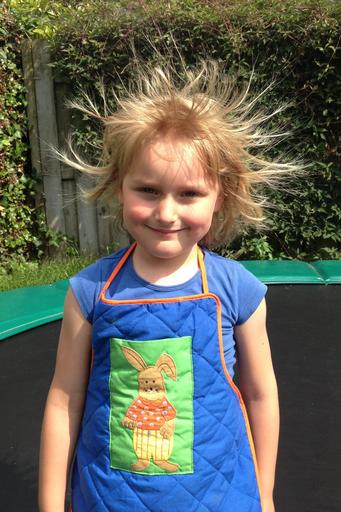
Before we get further into lightning, have you guys ever seen these scenarios? You comb your hair
with a plastic comb and see your hair standing at the end? You just remove your sweater and you see tiny sparks. You walk on a carpet barefoot and when you touch the door knob you kinda get a small shock and you withdraw your hand immediately. In the morning, when you get up after a peaceful night's sleep snuggled under your cozy blanket, you see tiny sparks when you remove your blanket. If you need to explain this is to your kiddo, perform the famous plastic comb attracts paper bits experiment. Shred paper into tiny bits. Take a plastic comb and run it through your hair or rub it against woollen sweater/sock several times. Now bring the plastic comb near the paper bits. You will find the paper bits sticking to the comb for a brief moment. All these are small scale versions of the lightning. Similar phenomena, but lightning is very large scale. 

One other thing we need to know about is the cloud. What are they made up of and how are they formed ? They are made up of tiny water particles. Water vapor is found in the air around us. As the water vapor rises into the atmosphere, it cools down into tiny water droplets and sticks onto the dust particles, ice or whatever small particles are present there, thus forming a cloud. These tiny particles of ice keep moving and rub against each other constantly. And when they do that, they rub off charge against one another. Just like the hair and the comb, these particles split up into positively charged particles and negatively charged particles.  And the positively charged being lighter rise up towards the top of the cloud and the negatively charged particles towards the bottom of the cloud. 

When these charges go on accumulating, and when the difference is wider, the electrons flow from the negatively charged side to the positively charged side to ease out the inequality,  thus forming lightning. This is intra cloud lightning. Similarly lightning can happen between two different clouds. Another scenario being between the cloud and the earth. The most dangerous form. It can cause real havoc at the site of incidence. The bottom of the cloud being negatively charged, repels electrons from the surface of the earth or anything that's jutting out of the earth. Thereby making that part positively charged. And eventually,  electrons flow from the bottom of the cloud to the nearest positively charged part on the earth. And the taller the building or the structure, the higher the risk of lightning strike. 

And these electrons while in transit, get so excited, when they return to their normal state they give out the energy in the form of light. And that's the lightning we see. The energy of the lightning is so huge that it rapidly heats the air through which it travels. The heat causes rapid expansion in the air leading to the monstrous thunder we hear. 

That being lightning, what can we do to stay safe ? We have lightning conductors that are placed on tall buildings to safely conduct the huge amount of electricity from the lightning into the earth, thereby avoiding the damage from it. Never stay near the trees during a storm. Try and switch off electric equipment during the storm. And if you see your hair standing straight during storm, meaning your hair is positively charged and you are at a risk of being a victim of a strike. Stay safe. Apparently, staying inside a car, without being in contact with the metal exterior can keep you safe. And that that acts like a faraday cage and could keep lightning away. 

Now, isn't that a new term. Faraday cage!

Just before learning about Faraday cage, let me pose another question. We understand that lightning happens when electrons flow from where they are abundant to a place where there is less of them. So potentially anything that is charged is at a risk. And the charges in the cloud come from constant rubbing or bumping of the tiny ice particles in the atmosphere, we said. What about a plane that flies high up in the air and happens to constantly rub against the particles in the air, or the cloud? Doesn't it sound like it is more susceptible to a lightning strike? Imagine how that would be... (God forbid .. touch wood and all the other good luck charms) Have you even given this a thought? How is the aeroplane protected? 

Two things. One I've to say that the plane also acts as a faraday cage.  (explanation a little ahead). And two, have you ever noticed small thin rods jutting out of the tail or the wings? If you haven't yet, do make it a point to look for them the next time you board the aircraft. For now, I'm attaching a picture of the rods here. These rods are called static discharge wicks. What do they do... give the electrons a way to escape into the air, thereby getting rid of the excess charge.Now the plane is neutrally charged. That minimises the chances of a spark or a strike.

However, in the unlikely event that the strike happens, the plane uses its other line of defence. It's aluminium body. The body acts as a good conductor and keeps the charge off the interior. There we are, that's what a faraday cage is. It keeps the charge on the exterior alone and shields the interior. So we are safe. Phew! A renowned scientist called faraday, conducted an experiment where he lined the exterior of the room with metal and passed current through it and proved that while the exterior is carrying the surge of electrons the interior is unaffected.

How does that work? I found a simple explanation from wikipedia. 


"Animation showing how a Faraday cage (box) works. When an external electrical field (arrows) is applied, the electrons (little balls) in the metal move to the left side of the cage, giving it a negative charge, while the remaining unbalanced charge of the nuclei give the right side a positive charge. These induced charges create an opposing electric field that cancels the external electric field throughout the box."

So the car is a faraday cage. Protects you from lightning. The plane is. New concept, but looks like its all around us right? Let's think of more examples to help you relate to it. Remember sometimes when we are in a lift, our phone conversation gets disrupted because of the loss of signal. I know what you are thinking. Cellphones don't use electricity to communicate. It uses radio signals. Absolutely. These radio signals are some form of electromagnetic radiation and the faraday cage tries its utmost to protect the interior from electromagnetic radiation.

If you are wondering what this new term 'electromagnetic radiation' is .. I'm going to break it up into tiny bits of essential information just enough to understand this article. Electromagnetic radiation has three terms : electro, magnetic and radiation. Remember, electric field and magnetic are inter related and one causes the other and vice versa. Radiation is the energy that is emitted out. To put it simple, energy released when certain electrical charges interact. UVrays , visible spectrum, IR, radio waves, gamma waves, X rays all are part of the electromagnetic spectrum. All waves. All have energy, length and frequency.That said, the faraday cage protects the interior from electromagnetic radiation.

Oh dear. Too technical isn't it? Let's deviate a tiny little bit and talk about something eerie. Yes, you heard it right, I did say eerie. We are going to talk about ghosts now. Spooky!! Do you guyz watch horror movies? That's one genre I honestly keep myself away from. Anyways, I happened to see one episode of a very popular television series called 'castle' where they investigate a murder of a ghost hunter. ( You guys wouldn't believe this .. but as of now, as I'm writing about this spooky subject, my lappy screen just turned on and off and the CD drive just automatically ejected the CD !!!) Hmmm.... back .. to .. the ... castle episode. So, while investigating they learn that ghost hunters use ElectroMagneticField Meter. It's a device that measures abnormal paranormal activity. ( God! I wish I had that with me now!!  ) That's one new term and concept I learnt the other day. Ghosts are or cause some sort of electromagnetic radiation. And that would mean ..... a Faraday cage can technically trap ghosts??? Wow.. what a thought! One other day, I saw yet another episode of yet another popular television series Doctor Who ( Yes, I do watch a lot of these series, but hey, look how informative they are !) , where they showed us exactly the same thing. Faraday cage and ghosts getting trapped in them. What an innovative use of a faraday cage that would be huh...

Some other uses of faraday cage : Electrical linemen wear faraday suit to protect them from electric shock. MRI room in a hospital is designed as a faraday cage to minimize interference from outside. Sometimes, high profile equipments are kept in a faraday cage to protect them from EMP, Electromagnetic Pulse. ( EMP destroys every electrical equipment in the vicinity.) How very handy.

That was about faraday cage. Now back to lightning. Have you ever wondered why lightning is never depicted as a straight line, and why it has a zigzag or a jagged shape? I read from the internet that lightning happens in many small steps. That is, when the bottom of the thundercloud assumes negative charge, the electrons take a leap, the first leap. Apparently, this first leap is only a few hundred metres long. Then, from the botoom of that leap, another leap happens and so on. Similary, the ground which had assumed a positive charge, sends its positive charge up in leaps and in steps. Now each of these steps are independent of each other and they chose their path of least resistance. Which is why lightning is zigzag.

Early men used to think of Lightning as a warning or punishment from God. We still do have that mythological stories talking about lightning as Indra's weapon Vajra, and as Zeus's weapon thunderbolt  according to the Greeks. But that was back then, when we had no knowledge of the science behind lightning. I hope this post has bestowed upon you the lightning enlightenment.  ( Is my heading justified now! Phew! )